SCALARWP SERVICES
WordPress engineering services
Whether you’re launching a business on WordPress or improving an existing site, we help you choose the right tools, build the features you need, and connect your operations. Explore our services or talk to us about your next step.
SERVICES
What each service actually covers
Explore what each service offers, who it’s for, and a real project example to find the right fit for your business.
WordPress business setup
Launch your business with a WordPress site, payments, plugins, and workflows set up to work together.
Bookings, jobs, payments and technician schedules running as one system.
How a system is set up →Custom WordPress integrations
Connect WordPress with your CRM, ERP, and payment tools so data moves automatically and your team spends less time on manual updates.
Website bookings pushed into Simpro, with Stripe payments kept in sync.
How integrations are built →Fluent ecosystem implementation
Set up and configure Fluent Forms, FluentCRM, FluentCart, and Fluent Support around how your business manages inquiries, sales, and customer service.
Per-recipient signatures sent from FluentCRM’s own email editor.
How the Fluent stack lands →Plugin extensions and addons
Extend your existing plugins with the features your business needs, built to work within the tools you already use.
Audit trail and role-gated contact lock added with zero core edits.
How an addon is built →E-commerce customization
Checkout flows, order logic and store operations built around how you sell.
Wishlist systems we ship and maintain as products on both platforms.
How stores are customized →Data migration
Non-native moves with planning, validation and a rollback path.
~5,000 live SureCart subscriptions moved with billing dates preserved.
How a migration runs →Technical consultancy
A senior review before you commit to a stack or a promise.
Build, buy, or leave it alone — including second opinions on someone else’s quote.
CHOOSING BETWEEN THEM
Two of them sound the same?
Three pairs cause most of the confusion. Here is the line between them.
Business system setup vs Fluent ecosystem implementation
Setup decides which tools your operation runs on and builds the whole stack. Implementation starts from the Fluent tools you have already bought and makes them work as one system.
Plugin extensions vs custom integrations
An extension adds a missing feature inside one plugin, on its own hooks. An integration moves data between systems that were never designed to talk.
Technical consultancy vs everything else
Consulting is the answer before the build. It ends with a recommendation and a specification, and that recommendation is sometimes to change nothing.
PROOF
Work we have shipped
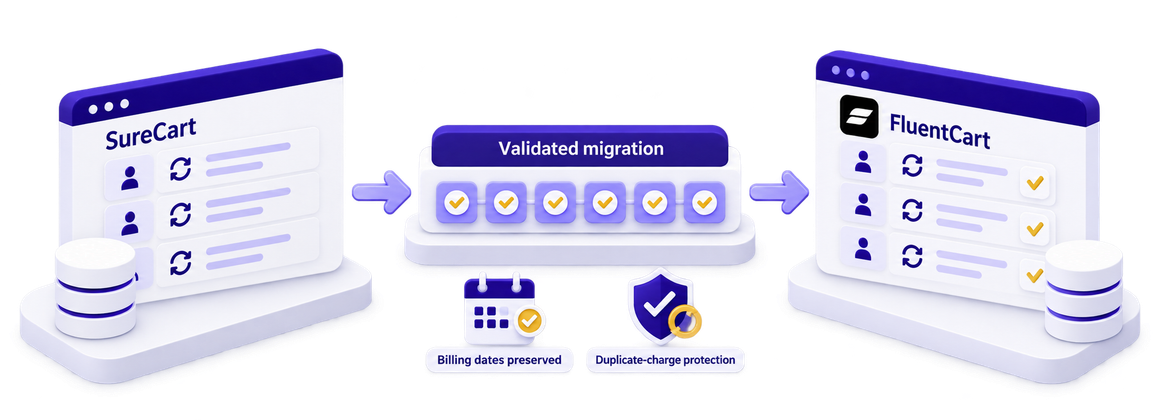
Moving 5,000 live subscriptions without missing a billing date
A Swedish subscription business had to leave SureCart for FluentCart without disrupting recurring payments. We built a resumable six-stage migration plugin with deterministic Stripe idempotency keys, pre-flight validation and post-cutover repair tools.
Result
Eligible subscriptions recreated with their original billing anchors preserved, and missing payment methods recovered through live Stripe lookup.
~5,000 subscriptions6-stage pipeline~75 automated tests
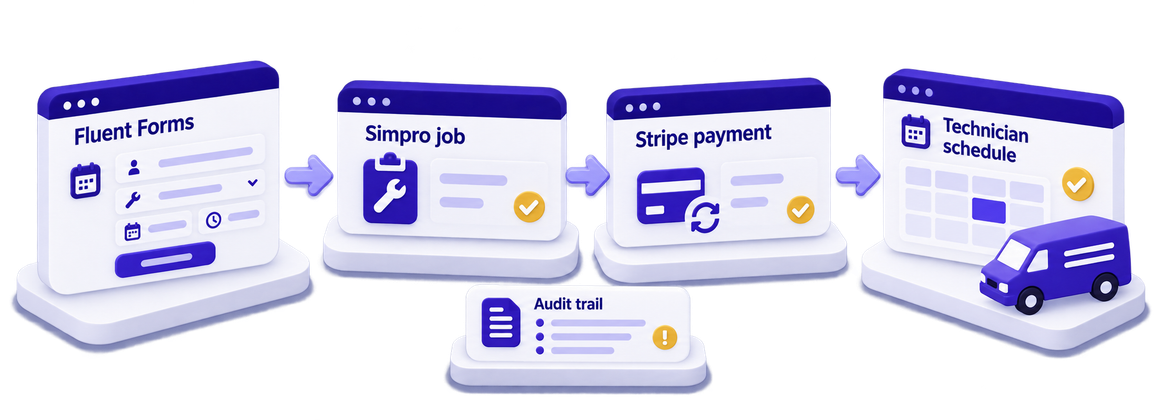
Connecting website bookings to field operations
A Dublin home-services operator needed bookings, Simpro jobs, Stripe payments and technician schedules to stay in sync — work that was being reconciled by hand. We built a custom integration plugin between Fluent Forms and the Simpro REST API.
Result
One booking path from the website through to the technician’s schedule, delivered April to July 2026.
36 booking forms7 REST endpoints3 admin panels

An audit trail and role-gated contact lock inside FluentCRM
FluentCRM reports that a contact changed, but not which field, from what value, or by whom. We added a field-level audit ledger and a two-layer protected-tags system, enforced at the REST boundary.
Result
Every edit carries a who, what, when and from-where, with no edits to FluentCRM core.
3 entry paths audited2 protection layers0 core edits
★★★★★
Together, we dissected the complex Peppol infrastructure and built a fully functional invoicing plugin with seamless, automated Peppol compliance from the ground up… Today, our Peppol Commerce plugin runs rock-solid in production.
Natascha Vantuykom
Founder, UCPro
via FluentWiz
DELIVERABLES
What your project includes
Every engagement is scoped on its own. These are the parts that recur, and what each one means in practice.
Not included: hosting, licences and third-party fees are yours.
Scope
A written scope with a fixed price and timeline, approved before anything is built. If the scope changes, we re-quote rather than run a meter.
Implementation
Plugin-native code on public hooks, landing in your repository as it is written rather than in one lump at the end.
Testing
Staging against real data, including the failure paths: refunds, retries, partial writes, expired tokens.
Documentation
Documentation and a runbook covering how it works and what to do when something breaks.
Handoff
A walkthrough with your team, and source, documentation and accounts in your name. The test is whether someone else could take over tomorrow.
Support
Support through launch is part of the build. Ongoing maintenance is available, agreed separately, and never bundled in by default.
HOW IT RUNS
Four stages, no open-ended hourly drift
01
Discuss the problem
You send the workflow and the stack. We read the plugins, the code and the data, and map how it runs today.
02
Agree the scope
A written scope with a fixed price and timeline. You approve what changes, what stays stock, and what happens on the edge cases.
03
Build and test
Plugin-native code in your repository, tested on staging against real data, including the failure paths.
04
Handoff
Documentation, a runbook and a walkthrough. You own the result. Ongoing support is available and never required.
QUESTIONS
Before you enquire
Not seeing your question? Discuss your project and we will tell you honestly what should be custom.
Not sure which one you need?
Bring the problem, not the solution. We will tell you which service it is, or that you do not need one.